Life in Medieval Europe by Danièle Cybulskie
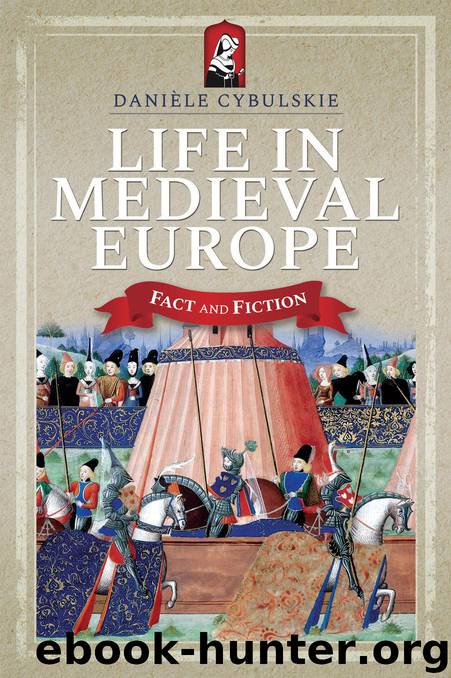
Author:Danièle Cybulskie [Danièle Cybulskie]
Language: eng
Format: epub
What about knights?
Knights were a different class altogether, and required a lifetime of training, usually a noble pedigree, and a massive amount of equipment. While knighthoods could be – and were – granted on the field, it was unkind for a king to knight a commoner unless he was willing to help him afford the kit he needed.
Knights were called chevaliers in French, from the word for horse (cheval). This is also where we get the word for knightly behaviour: chivalry.
The most obvious mark of a knight was his horse. A knight’s warhorse was called a destrier and was trained not only to be fearless in the midst of the sounds, sights, and smells of the battlefield, but also to be a partner to his rider. Destriers were trained to stomp, kick, bite, and charge directly into combat. This isn’t to say that the horses were never afraid; occasionally they caused all kinds of havoc through the sheer terror of being injured and trapped in the midst of a battle. Rather, the best destriers were strong, agile, well-trained, and courageous. They were extremely valuable and expensive, which is why it was so painful for a knight to lose one at a tournament.
The skills required to both win a battle and hold onto your horse at tournament were honed by daily practice. Knights spent hours tilting at quintains with lances in imitation of the cavalry charges they’d be required to perform on the battlefield. Quintains were wooden t-shaped posts that were capable of swivelling on a central axis. A target was attached to the end of one of the quintain’s arms, with a weight (like a sandbag) attached to the other. If a knight’s lance hit the quintain’s target at the right angle and speed, it would swing around harmlessly. If he missed or rode too slowly, the sandbag swung around and hit him, sometimes knocking him from his horse.
Of course, once a knight was off his horse (whether by accident or by design), he had to know how to fight on foot using swords, poleaxes, and daggers. Late-medieval two-handed swords could be over 3 ft long, although it was sometimes more practical to use shorter ‘bastard swords’, so called because they could be used either one-handed or two-handed. Even if a knight’s sword failed to pierce his opponent’s armour, the weight of his blow could still cause internal damage. Knights were most vulnerable at the gaps in their armour: neck, face, and groin. Neck and face wounds were, of course, often fatal, and a stab or slash to the groin could cut the femoral artery, meaning the enemy would bleed out quickly and die on the field.
Full armour for a late medieval knight involved quite a lot of equipment. On top of his tunic and hose, he’d wear a quilted aketon to absorb some of the impact from blows and to keep his armour from chafing. Then he’d put on a mail shirt (hauberk), a mail hood (coif), and mail leggings.
Download
This site does not store any files on its server. We only index and link to content provided by other sites. Please contact the content providers to delete copyright contents if any and email us, we'll remove relevant links or contents immediately.
| Africa | Americas |
| Arctic & Antarctica | Asia |
| Australia & Oceania | Europe |
| Middle East | Russia |
| United States | World |
| Ancient Civilizations | Military |
| Historical Study & Educational Resources |
Room 212 by Kate Stewart(5119)
The Crown by Robert Lacey(4814)
Endurance: Shackleton's Incredible Voyage by Alfred Lansing(4780)
The Iron Duke by The Iron Duke(4354)
The Rape of Nanking by Iris Chang(4211)
Joan of Arc by Mary Gordon(4109)
Killing England by Bill O'Reilly(4001)
Say Nothing by Patrick Radden Keefe(3984)
I'll Give You the Sun by Jandy Nelson(3447)
Shadow of Night by Deborah Harkness(3367)
Hitler's Monsters by Eric Kurlander(3342)
Mary, Queen of Scots, and the Murder of Lord Darnley by Alison Weir(3210)
Blood and Sand by Alex Von Tunzelmann(3203)
Eleanor & Park by Rainbow Rowell(3172)
Darkest Hour by Anthony McCarten(3129)
Margaret Thatcher: The Autobiography by Thatcher Margaret(3082)
Book of Life by Deborah Harkness(2938)
Red Famine: Stalin's War on Ukraine by Anne Applebaum(2933)
The One Memory of Flora Banks by Emily Barr(2863)
